The product I built the company around
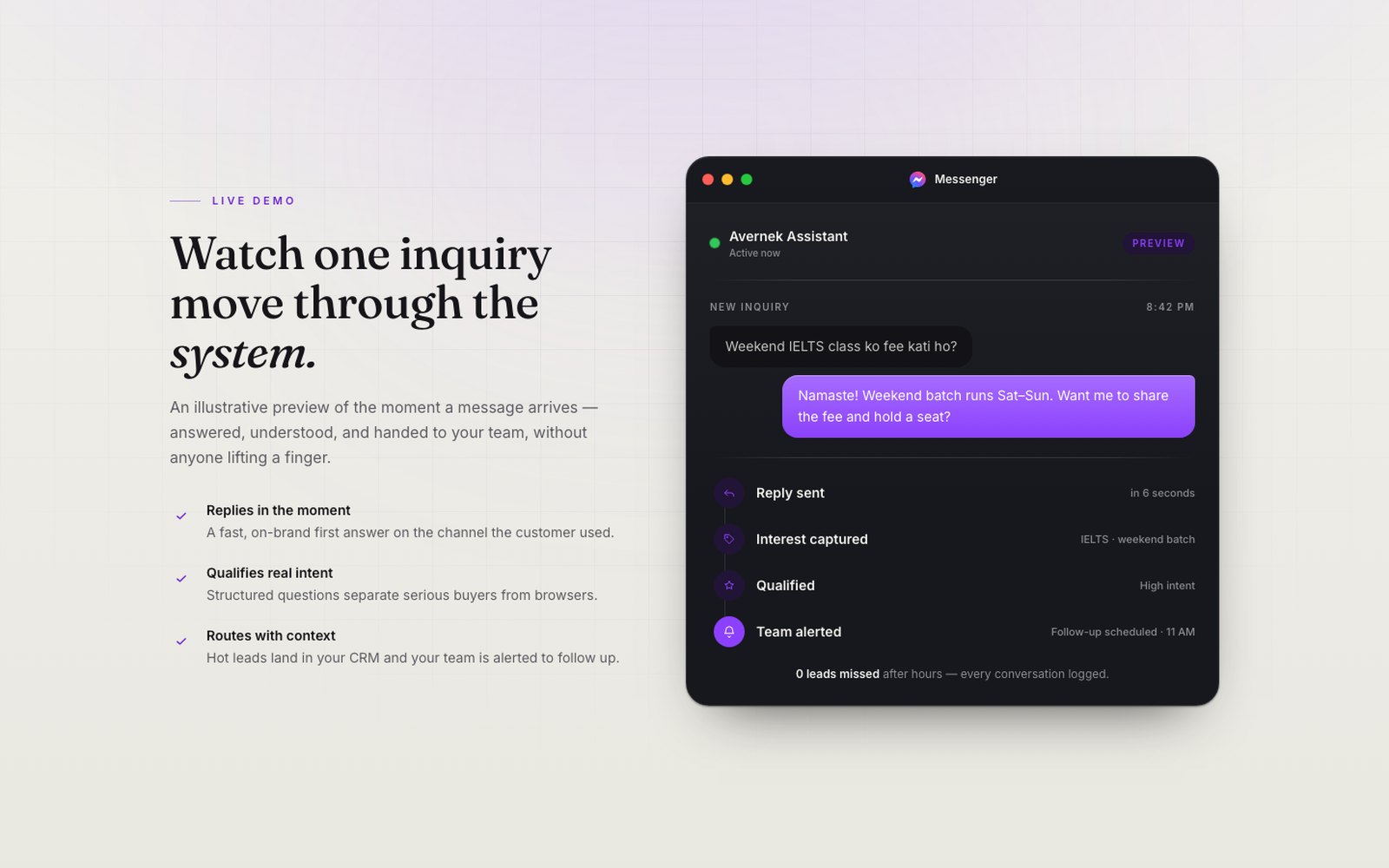
Businesses running ads collect messages across Facebook, Instagram, WhatsApp, web forms and marketplace listings. Avernek sells the system that answers them. My part is deciding what it does and what it must never do, sitting with the client to work out what the business actually knows, then pricing it and closing it. Our CTO builds it.
- Product definition, Client discovery, Pricing and closing, Team lead
- 2026
- Delivered
- Discovery interviews · Knowledge design · Escalation rules · Client delivery
Client names withheld pending permission.
The problem underneath the problem
Every business asked for the same thing, 'reply to messages automatically', and every business meant something different by it. A clinic needs to know which treatment, which branch, and whether it's urgent. A showroom needs to know the model, the budget and whether the person can actually visit. A property business needs the location and whether the enquiry is a buyer or a broker.
A single generic auto-reply is worse than no auto-reply, because it tells the customer they're talking to a wall. The system had to hold a specific business's actual knowledge and behave differently depending on what was being asked.
How a message becomes a qualified lead
Five of these steps are the world the business already lives in. The middle four are the system.
Customer
Sees an advert or a post and sends a message.
Channel
Facebook, Instagram, WhatsApp, web form, or a marketplace listing.
Capture
Every message is recorded the moment it lands, so nothing depends on someone noticing.
Intent
What is this person actually asking for, and how urgent is it?
Knowledge
The business's own answers: services, branches, prices and hours, not general knowledge.
Qualify
Serious buyer or browser. Scored, so the team knows who to call first.
CRM
One structured pipeline the owner can actually see.
Human
Escalated to a person with the context already gathered.
Report
Response speed, lead quality and follow-up status, back to the owner.
Where the product comes from
Our CTO builds the engine. My part is everything in front of it: sitting with the owner, working out what the business actually knows, and turning what's in their head into a structure the system can answer from.
That's most of the delivery time on every build. Which questions have exactly one correct answer. Which change by branch, service or season. And which must never be answered by a machine at all.
That last category is the one I care about most. Anything touching a medical opinion, a firm price commitment or a complaint goes straight to a person. Clients are usually surprised by how much we refuse to automate, and it's the part of the scope I argue hardest for.
Honest limits
This is presented as architecture rather than results. The performance figures belong to the clients who paid for the systems, and they haven't been cleared for publication here. Nothing in this case study contains a client's private workflow, credentials, or data.